
Passive income calculator
Pick the income you want from your money, set what it can earn a year, and see how much capital that takes — and how long it takes to get there with what you already have and what you add each month.
Your target
Your savings as a share of the capital you need. The line is 100% — the goal.
A simplified model: steady yield, inflation and contributions. Real returns vary year to year and are not guaranteed. Not investment advice.
How much do I need to invest to make $3,000 a month?
The rule of thumb is simple: capital = yearly income you want ÷ yield. $3,000 a month is $36,000 a year. At a 4% yield you need $900,000; at 6% you need $600,000.
$100 a day is $36,500 a year, so at 4% it takes about $912,500 and at 5% about $730,000. The lower the yield you can count on, the bigger the pile has to be.
Why the 4% rule is the honest starting point
Interest and dividends look generous until you subtract inflation and tax. If your savings pay 4.5% and prices rise 3%, only about 1.5% is real income you can spend without the capital shrinking.
The 4% rule comes from retirement research: withdrawing about 4% a year has historically left a diversified portfolio lasting for decades. Use it as a conservative anchor, then compare it with your real options — savings, bonds, dividends or a rental.
What people forget
- Inflation: income that stays flat buys less every year.
- Tax: interest, dividends and rent are usually taxed.
- Costs: a rental pays rent minus vacancy, repairs and fees, not the full rent.
- Risk: higher yields usually mean bigger swings or a chance of losing money.
- Liquidity: money tied up in property is slow to reach when you need it.
How to get there faster
Time and monthly savings do most of the work. Raising what you add each month usually shortens the path more than chasing a higher yield — and it starts with knowing what you really earn and keep every month.
Passive income starts with active income you can see.
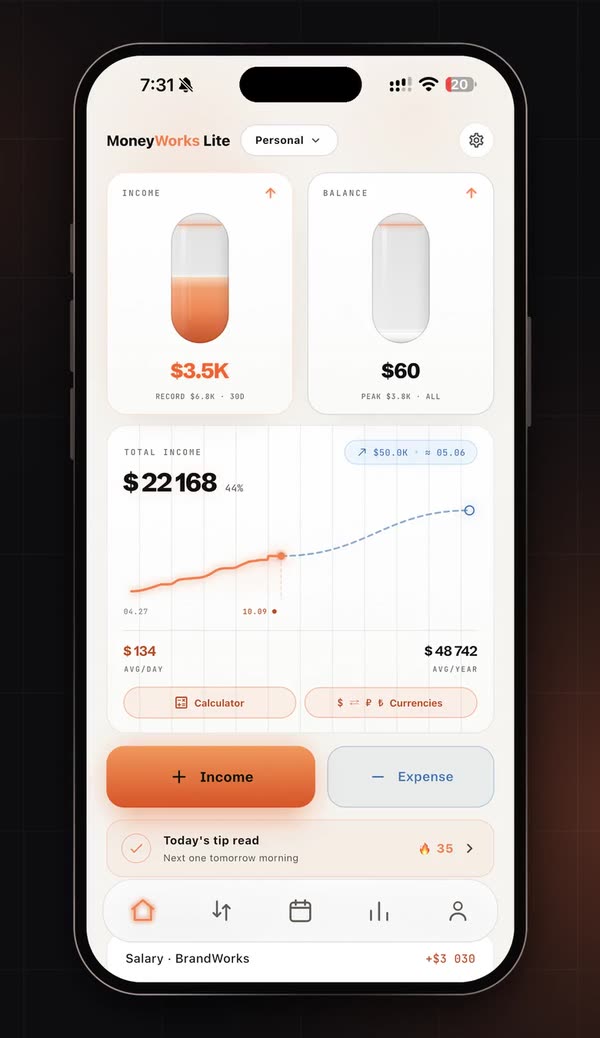
MoneyWorks Lite shows your rolling 30-day income, daily pace and an estimated timeline to your next goal, so you know how much you can set aside each month. Free to download, with 7 days of Pro included.
Common questions
How much do I need to invest to make $1,000 a month?
$1,000 a month is $12,000 a year. At a 4% yield you need about $300,000; at 6% about $200,000. Inflation and tax push the number up.
How much do I need to invest to make $100 a day?
About $912,500 at a 4% yield ($36,500 a year ÷ 0.04), or about $730,000 at 5%.
What is the 4% rule?
A rule of thumb from retirement research: spending about 4% of a diversified portfolio a year has historically let it last for decades. It means you need about 25 times the yearly income you want.
Should I use the yield before or after inflation?
After, if you want your income to keep its buying power. The calculator subtracts the inflation you enter from the yield.
Is this investment advice?
No. It is a simplified model with a steady yield. Real returns go up and down and are never guaranteed.