
Freelance profit calculator
Your income is just two numbers: how many projects you get paid for and how much each one pays. Take-home pay is that income minus costs and taxes. Enter your numbers to see what you really keep each month — and what +10% on each lever changes.
Your numbers today
Now pull the levers
Fixed costs stay put. Only the number of projects and the average price move.
A simplified model: fixed costs stay flat, variable costs and taxes stay the same %. In real life more projects may need more hours or tools — factor that in yourself.
Two levers, nothing else
Ask a freelancer how their income is built and you often hear “it depends on the month”. It does — but every month is the same two numbers multiplied together.
Better portfolio, more posts, a new platform, a discount — all of it reaches your income only through these two levers: how many times you get paid and how much you get paid each time. You can cut costs, but costs have a floor. The two levers don’t.
Why profit grows faster than income
Move both levers by 10%. Income grows 21%: 1.1 × 1.1 = 1.21. Two small moves, and the effect is bigger than either one alone. Take-home grows even a little faster: your software, laptop and coworking don’t cost more because you landed another client, so once fixed costs are covered every extra project goes to profit. The higher your fixed costs, the stronger this gets.
That’s why two small wins — one more client and a slightly higher price — usually beat one big painful move like cancelling every subscription. Costs have a floor; the levers don’t.
How to get more projects
- Ask for referrals. A happy client who introduces you is the cheapest new project you’ll ever get.
- Show the work. A portfolio with results and prices answers questions before the first call.
- Reply fast. An inquiry answered tomorrow has often gone to someone else today.
- Bring clients back. Repeat projects and check-ins with past clients fill the gaps between new ones.
How to raise your average price
- Raise prices for new clients. Start with the next quote, not your oldest client.
- Packages instead of hours. “Basic / standard / premium” — many people pick the middle option.
- Retainers. A monthly fee for ongoing work is a higher ticket and a steadier month.
- Fewer discounts. A 10% discount on a 30% margin wipes out a third of the profit on that project.
One more client a month puts $6,480 a year in your pocket.
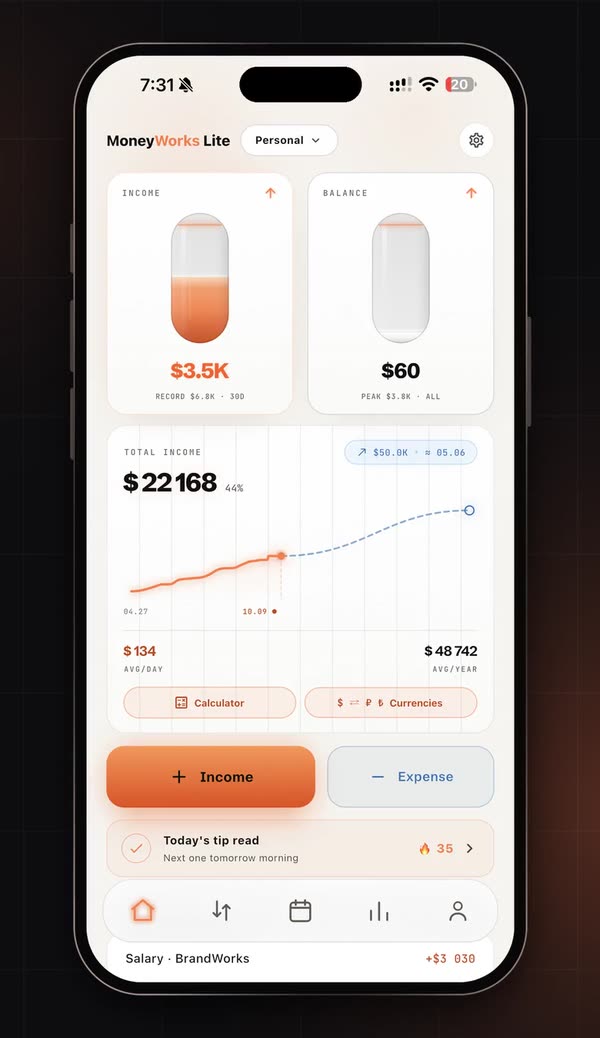
The calculator is a snapshot. Your income moves every day. MoneyWorks Lite tracks the real numbers: rolling 30-day income, daily average, yearly pace and a forecast to your goal, income by client, Pay Yourself and a home-screen widget. Free to download, with 7 days of Pro included.
Common questions
How do I calculate my freelance income and profit?
Income is the number of projects you get paid for in a month multiplied by your average price. Profit is income minus costs: variable costs that grow with each project (platform and payment fees, materials) and fixed costs that stay the same each month (software, rent, gear). Take-home pay is profit minus what you set aside for taxes.
How much should a freelancer set aside for taxes?
It depends on your country and tax status. In the US, self-employed people often set aside 25–30% of profit to cover income tax and self-employment tax. Treat any percentage as a guide and confirm it with an accountant.
What is the break-even point for a freelancer?
It is the number of projects a month at which your income covers all your costs. Divide fixed monthly costs by what each project leaves after variable costs. Everything above it is profit.
Why does profit grow faster than income?
Fixed costs don’t grow when you take on more work. Once they are covered, each extra project adds only its variable cost, so +10% projects and +10% price (21% more income together) lift take-home pay by more than 21% — the higher your fixed costs, the bigger the gap.
Why track income if my accountant handles the numbers?
An accountant reports what already happened. Deciding how to get more clients and when to raise prices is your call, and it starts with knowing your two numbers every week, not once a year.