
ROI and payback calculator
Put in what you invest, what it brings in each month and what it costs to keep. The calculator shows your yearly return, how many years it takes to get your money back and what the whole investment returns over the years you hold it — for a rental apartment, commercial property, a business or a fund.
Your investment
Cash flow collected as a share of what you invested. The line is 100% — that’s payback.
A simplified model: income and costs stay flat, value changes at a steady rate, cash flow isn’t reinvested. Not investment advice.
How to calculate ROI and payback
Payback period answers “how many years until I get my money back?”: divide the investment by the net cash flow it brings each year. An apartment bought for $250,000 that leaves $15,000 a year after vacancy and costs pays back in about 17 years.
Yearly return is the same thing turned around: net cash flow per year divided by the investment. $15,000 on $250,000 is 6% a year.
ROI over the whole holding period adds what happens to the asset itself. If the apartment also grows in value, the profit when you sell is part of the return — if it loses value, as equipment does, that loss is too.
Apartment, commercial property, business: what changes
Rental apartment. Steady demand and easy to resell, but rents are modest compared to the price, so payback is long. Vacancy, repairs and management decide whether the yield is 6% or 4%.
Commercial property. Offices, shops and warehouses usually rent for more per dollar invested and tenants often pay some costs themselves, but empty months last longer and one tenant can be most of the income.
Business or equipment. A coffee machine, a car for deliveries or a small shop can pay back in a few years, but the asset wears out. Count its value falling, not growing.
Stocks and funds. Most of the return comes from price growth, not monthly income, so the payback line barely moves — look at total ROI over the years instead.
What people forget to count
- Purchase costs: closing costs, agent fees, taxes and repairs before the first tenant are part of the investment.
- Empty months: a property is rarely rented 12 months out of 12.
- Upkeep: repairs, appliances and maintenance grow with the age of the building.
- Taxes and fees: tax on rental income, property tax, management fees.
- The alternative: compare the yearly return with a savings account or bond. If the difference is small, you’re taking on a lot of work for little.
What if I buy with a loan?
Put only your own money in Investment — the down payment plus costs — and add the monthly loan payment to Costs. The calculator then shows the return on your own cash, which is what matters to you.
A separate profile for every property.
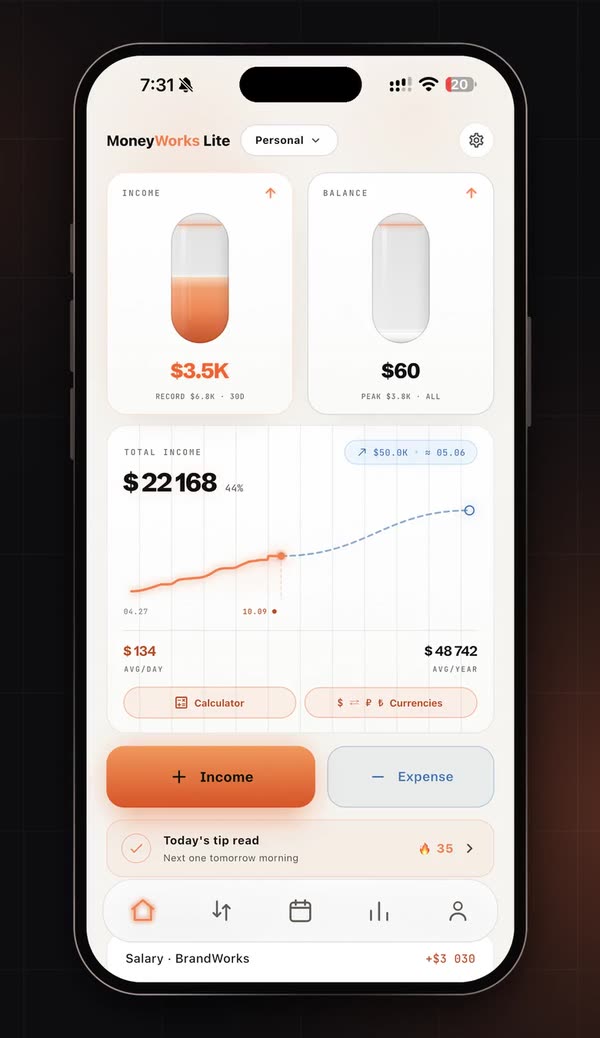
MoneyWorks Lite keeps each rental or project in its own profile with its own currency, income, expenses and balance, so you see what every investment really brings in month after month. Free to download, with 7 days of Pro included.
Common questions
How do I calculate the payback period of an investment?
Divide the amount you invested by the net cash flow it brings each year. For example, $250,000 that brings in $15,000 a year after vacancy, costs and taxes pays back in about 16.7 years.
What is a good ROI on a rental property?
It depends on the country, city and interest rates. A useful test is to compare the yearly cash return with what a savings account or government bond pays: the property should beat it clearly, because it takes more work and carries more risk.
How is ROI different from yearly return?
Yearly return looks only at cash flow in one year. ROI over the holding period also counts what happens to the value of the asset, so a property can have a modest yearly return but a higher total ROI if its price grows.
Should I include the mortgage in the calculation?
Yes, but the right way: put your own money (down payment and costs) as the investment and add the loan payment to monthly costs. That shows the return on the cash you actually put in.
Is the calculator investment advice?
No. It is a simplified model that keeps income, costs and value growth steady. Real numbers change, so use it to compare options and check your assumptions, not as a forecast.
What is the payback period formula?
Payback period = investment ÷ yearly net cash flow. For example, $250,000 ÷ $15,000 a year ≈ 16.7 years. If cash flow changes from year to year, add up each year’s cash flow until the total reaches the investment.
Is the payback period the same as the break-even point?
No. Payback period is time: how many years until cash flow returns what you invested. Break-even point is volume: how much you must sell or rent each month to cover costs. A property can be cash-flow positive from month one and still take 17 years to pay back.